From Traffic Gatekeeping to Quality Insight: A 2026 Guide to Building Enterprise-Grade LLM Observability Systems
As large language models (LLMs) evolve from “novelty toys” into the “productivity backbone” of enterprises, a question that every technical leader keeps coming back to has surfaced: When API calls become a black box, how do we manage these massive, expensive AI models with the same rigor we apply to databases or microservices?
If 2024 was the year everyone was busy “getting demos to work,” then 2026 marks the dawn of “fine-grained governance.” The simple “call succeeded/failed” logs of the past can no longer answer today’s complex operational questions: “Why was this agent so smart yesterday, but today it’s spouting nonsense?”, “Why did our token costs suddenly double last month?”, “Is someone trying to attack our customer service bot with a prompt injection?”
This article breaks down the three dominant LLM monitoring architectures based on the latest industry practices and provides a practical guide for choosing your stack.
Architecture Evolution: From “Monitoring VMs” to “Business Semantic Insight”
The approach to LLM monitoring is undergoing a paradigm shift from the “infrastructure layer” to the “content semantic layer.” Current industry solutions can be clearly divided into three tiers:
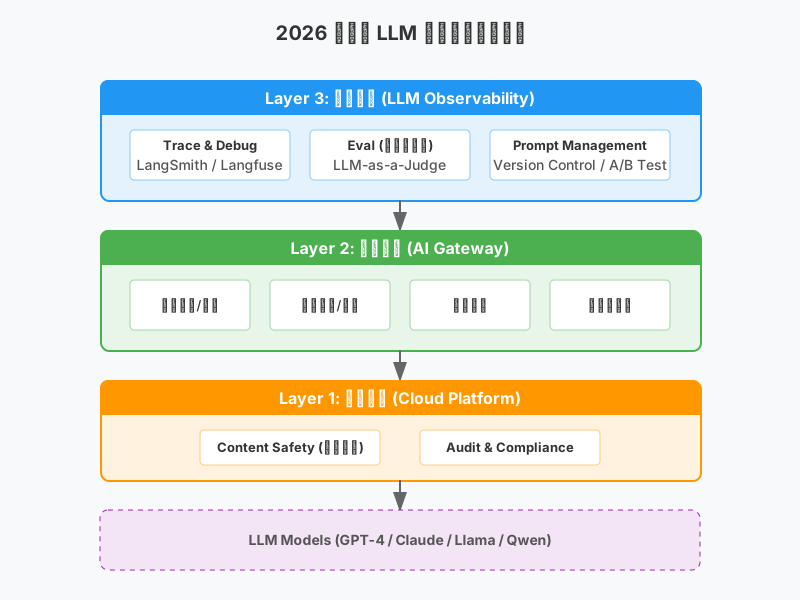
Tier 1: Infrastructure Governance — Platform-Native Monitoring
This is the most basic line of defense, similar to cloud provider VM monitoring (CloudWatch/Azure Monitor).
- Core Logic: Directly leverage the built-in console capabilities of the Model Provider.
- Key Players: Azure AI Foundry, AWS Bedrock.
- Key Capabilities:
- Content Safety: This is the platform’s killer feature. For example, Azure can intercept hate speech, self-harm tendencies, or violent content at the infrastructure level before the model even outputs it. This “guardrail” sits right next to the model inference engine, offering the lowest latency.
- Basic Auditing: Provides token consumption metering and basic API call logs.
- Limitations: It’s a “walled garden.” If you use both GPT-4 and Claude 3.5 for disaster recovery, or even mix in a locally deployed Llama 3, the data scattered across different cloud backends creates new silos that are impossible to manage uniformly. Furthermore, this layer focuses more on infrastructure-level monitoring and struggles to reach business semantics.
Tier 2: Traffic Hub — The AI Gateway
This is the most critical “strategic stronghold” in current enterprise architectures. Just as we needed an API gateway in the microservices era, in the LLM era, we need an AI-aware gateway to intercept traffic.
- Core Logic: Establish a unified Proxy between business applications and models, enabling “one integration, any model.”
- Key Players: Kong AI Gateway, APISIX, Higress.
- Core Value:
- Unified Auth & Rate Limiting: No matter how many backend models are connected, frontend applications only need one key from the gateway. This prevents a single bug in one business line from burning through the company’s entire monthly token budget in one night.
- Model Routing & Degradation: When Azure’s GPT-4 endpoint times out, the gateway can automatically switch to AWS Bedrock’s Claude 3 in milliseconds, or fall back to a local Qwen model. The business application remains completely unaware.
- Caching for Speed: For frequently asked, repetitive questions like “What is the company’s billing address?”, the gateway returns a cached answer directly, saving both money and time.
- Security Policy Enforcement: Integrate Prompt Injection detection plugins at the gateway layer, working in tandem with application-side checks to build a robust security defense.
Tier 3: Quality Insight — LLM-Specific Observability
This is a new breed of tooling born specifically to solve “hallucinations” and “debugging difficulties.” Traditional gateways can only tell you “the API call succeeded,” but this layer helps you evaluate “was the answer correct?”
- Core Logic: Collect runtime context information from applications via SDKs or Sidecars, delving into the semantic chain of requests and responses.
- Key Players: LangSmith (by LangChain), Langfuse, Helicone.
- Core Value:
- Traces: In complex Agent applications (e.g., search, then summarize, then polish), when something goes wrong, you need to know which step failed. A trace view records the input, output, token consumption, and latency for each step, helping developers quickly pinpoint the issue.
- Evals (Automated Evaluation): This is the most critical monitoring metric for 2026. The system automatically uses a stronger model (LLM-as-a-Judge) to score every conversation: How relevant is it? Are there hallucinations? Are there factual errors? While we can’t truly see inside the model’s black box, we can quantify its performance through these external observation metrics.
- Prompt Iteration Management: Offers prompt versioning and A/B testing. You can visually see that “changing the prompt from V1 to V2 resulted in a 5% increase in user upvote rate.”
Selection Guide: Building Your “Trinity” Defense Tower
For teams building enterprise GenAI applications, don’t choose between a “gateway” and an “observability tool.” Instead, build a combined strategy:
- Infrastructure Layer (Mandatory): Enable your cloud provider’s Content Safety (e.g., Azure). This is the lowest-cost, most effective safety net, filtering out the vast majority of compliance risks.
- Traffic Control Layer (Mandatory for Production): Deploy an AI Gateway (e.g., APISIX/Kong). Never let your business code call the model API directly. The gateway is your single point of control for cost, high availability, and unified authentication.
- Application Iteration Layer (Mandatory for Development): Integrate an LLM Observability Tool (e.g., Langfuse/LangSmith). Without it, prompt optimization is guesswork. With it, you can drive model improvements with data.
Conclusion
In 2026, simple “connectivity monitoring” is a thing of the past. A mature AI team needs the comprehensive ability to control who uses the model via a gateway, control what the model can say via platform guardrails, and analyze how well the model is performing via observability tools. This isn’t just a stack of technologies; it’s the key to maximizing the value of your AI assets.
🤖 AI Related Posts by semantic similarity
Want updates? Subscribe via RSS
Related Content
- From Azure SRE Agent to HolmesGPT: AIOps Practices in Multi-Cloud Kubernetes Environments
- Cilium 2026 (Continued): How the Unified Data Plane Is Reshaping Kubernetes Platform Architecture
- Weekend Project: Building a Local Load Balancer for LLM API Keys
- Practical · Building a Memory-Enabled AI Writing Partner (Part 4): Observability (Metrics + Logs + Trace + Cost)
- Practical · Building a Memory-Enabled AI Writing Partner (Part 3): Security Architecture (RAG Protection, Fact Guard, and BYOK)